
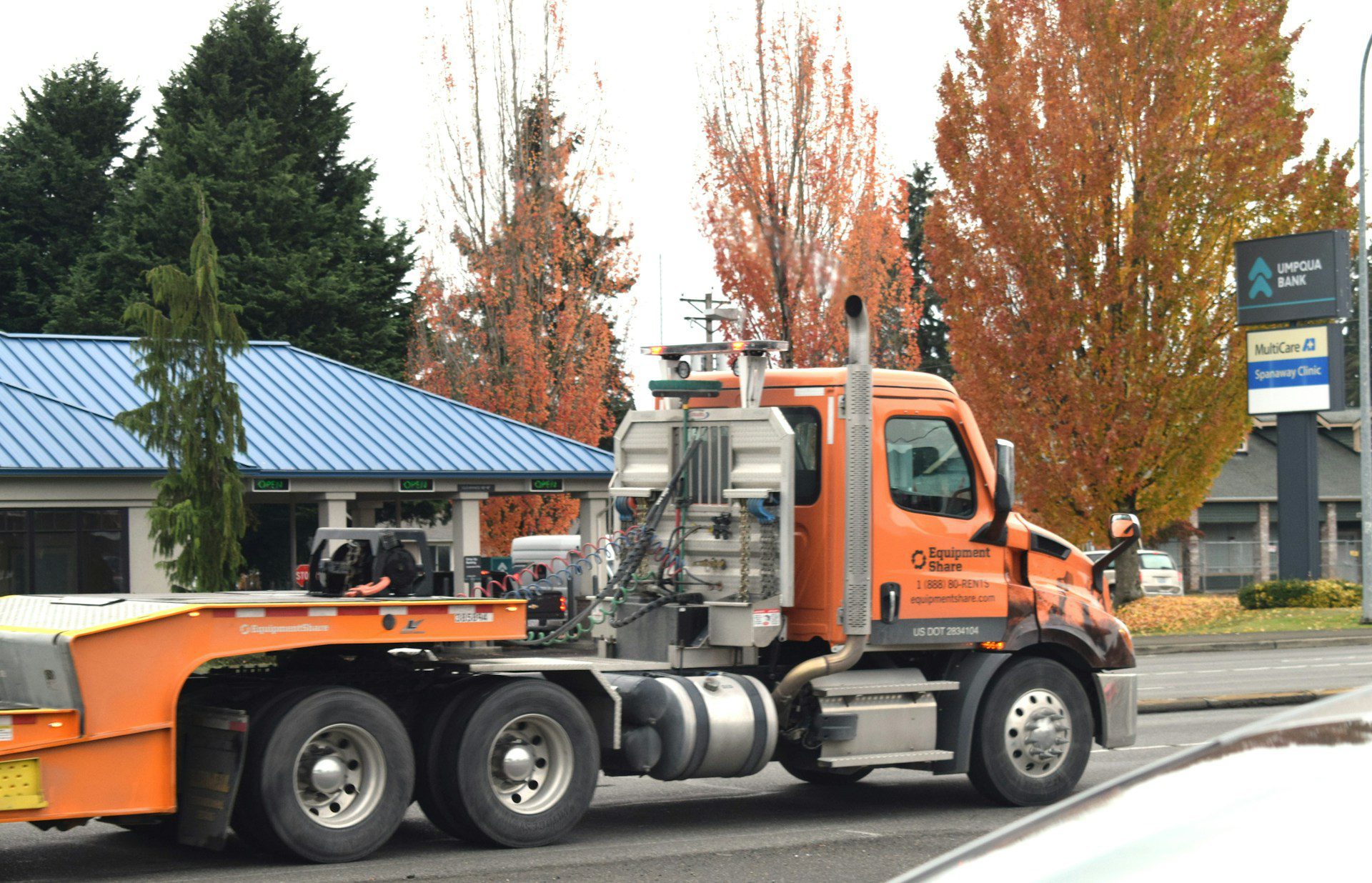
You take the cloverleaf off-ramp a little hot with a slide-in camper on the back, and the whole truck leans toward the outside of the curve like it wants to keep going straight. The steering goes vague, the cabinets in the camper rattle, and you lift off the throttle a lot sooner than you meant to. If you have ever wondered what does a sway bar do, that moment is the answer in action: it is the part working hardest to stop that lean, and on a tall, heavy truck it has more to fight than on almost any other vehicle.
A sway bar ties the left and right sides together
A sway bar, also called an anti-roll bar or stabilizer bar, is a U-shaped length of spring steel that runs across the truck from one side to the other. The long middle section mounts to the frame in two rubber or polyurethane bushings, so it can rotate. Each end connects to the axle or suspension on its side through a short end link.
When both wheels move up and down together, such as over a speed bump taken square, the bar simply rotates in its bushings and does almost nothing. When one side compresses and the other extends, which is exactly what happens when the body leans in a turn, the bar has to twist along its length to allow it. Steel resists twisting, so the bar pushes the low side up and pulls the high side down. The result is less body roll.
That is the whole trick. A sway bar does not hold the truck up and it does not damp bumps. It only resists one motion: the two sides of the truck moving in opposite directions.
Why body roll is a bigger deal on a heavy-duty truck
Every truck rolls in a corner, but HD pickups stack the deck against themselves. They ride tall, so the center of gravity sits high. They carry heavy loads that often sit high too: a camper, a loaded rack, a fifth wheel hitch, a service body full of tools. And their springs are rated for maximum load, which gives them plenty of vertical support but not much help resisting lean when the weight shifts sideways.
A higher center of gravity gives cornering force a longer lever arm to tip the body. As the body leans, weight transfers to the outside tires, the inside tires go light, and the truck's grip and steering response both suffer. The sway bar is the component that limits how far that transfer progresses before the springs and tires take over.
You feel the difference in more places than cloverleafs:
- Lane changes and evasive moves. A truck with good roll control settles quickly after a sudden steering input instead of rocking side to side.
- Crosswinds and passing semis. Tall sides catch wind, and a stiffer roll setup keeps the body from wallowing in the gusts.
- Off-camber driveways and crowned roads. Less lean means the load stays where you put it.
- Towing. When the trailer pushes the rear of the truck around in a curve, a well-controlled body keeps the hitch and the truck working together.
One clarification matters for towing. A sway bar on the truck controls the truck's body roll. It does not stop a trailer from swaying behind you. Trailer sway comes from the trailer's own loading and dynamics, and it is a separate problem with separate fixes.
Front bar, rear bar and the balance between them
Most heavy-duty pickups come with a front sway bar. Some configurations also have a rear bar, and it is a common upgrade for trucks that carry campers or heavy bed loads.
The two bars share the job of resisting roll, and how stiff each one is changes how the truck behaves at the limit. More roll stiffness at the front tends to make a truck push wide in a turn (understeer). More at the rear tends to make the back end feel more eager to rotate. Truck makers set the balance for predictable, safe handling with a typical load. When you add a large load at the rear, that balance shifts, which is why owners who carry a camper or heavy equipment often find that a rear bar or a stiffer pair transforms how the truck feels.
The details depend on your truck, its axle layout and what you carry, so changes to sway bar sizing are worth planning with a qualified suspension shop instead of picking a bar by diameter alone.
Where a sway bar costs you: articulation off-road
The same stiffness that keeps a loaded truck flat on pavement fights you on a rocky trail. Off-road, you want each wheel free to drop into a hole or climb a ledge while the others stay planted. A sway bar resists exactly that kind of opposite-side movement, so it can lift a tire off the ground when the terrain twists the axle.
A tire in the air has no traction, and on a heavy truck that can mean spinning in place on an obstacle that a more flexible setup would walk over. This is why some off-road builds use sway bars that can be disconnected at low speed, and why long-travel overland setups look closely at how roll control and articulation trade against each other.
The trade-off is simple to state: more roll stiffness means a flatter, more stable truck on the road and less wheel articulation on the trail. Any passive bar is a fixed compromise between the two.
Tired of choosing between a flat ride on the highway and flex on the trail? Look at how AdaptiveMotion™ for HD pickups manages every corner on its own and holds the body level through as much as 33 degrees of tilt, all mounted on a 4-link that bolts to both axles.
Signs your truck needs more roll control
Factory sway bars are sized for an average load. If your truck regularly works outside that average, you will usually notice it:
- The body leans noticeably in on-ramps, roundabouts and sweeping curves, even at moderate speeds.
- The truck rocks side to side for a beat after a lane change.
- A camper or tall load sways in the mirrors on crowned or rutted roads.
- Crosswinds push the body around and you find yourself making constant steering corrections.
- Clunks or rattles come from the front end over bumps, which can point to worn links or bushings rather than an undersized bar.
If the last item sounds familiar, have the links and bushings inspected first. A sway bar with a broken or worn connection can't do its job no matter how thick it is.
Extreme-duty sway bars as part of a staged build
Patriot Dynamic Systems sells its suspension as a ladder you climb at your own pace. Rung one of the passive side is a set of gas shocks, rung two brings the full bolt-on 4-link, and the third rung is a pair of Patriot extreme-duty sway bars, front and rear. A track arm and a steering stabilizer come after that, and the top of the ladder is the fully active system. An owner who mostly fights lean with a camper aboard can start with the parts that address it and keep going later.
Going active changes who sets the roll compromise. AdaptiveMotion™ puts a sensor inside every shock, each one checking the road a thousand times a second, and the controller trims damping, ride height and leveling corner by corner, with no switch for the driver to flip. The body is held level in motion, side to side and front to back, through as much as 33 degrees. A passive bar picks one setting and lives with it; an active system keeps re-deciding as the load shifts and the road changes.
Practical points for anyone planning a build:
- Removable equipment. Everything bolts to factory mounting locations and nothing is cut or welded. Each system carries a serial number, so when you trade trucks, your sway control comes with you.
- Professional install only. An authorized upfitter fits it and handles the diagnostic sign-off and registration that start the warranty.
- Warranty. The shocks are warrantied for 10 years or 1,000,000 miles, and coverage ends at whichever of those two marks your truck reaches first. Supporting parts, the sway bars among them, get 3 years. The warranty terms have the details.
- Trucks it fits today. Owners of a Ram 2500, 3500, 4500 or 5500, or a Super Duty in the Ford F-250 to F-550 span, can order today. Chevy and GMC kits are on the calendar for December 2026.
Every capability is laid out on the AdaptiveMotion™ overview. If your truck spends time on dirt as well as pavement, the overland suspension page shows how lift, travel and leveling work together.
The short version for truck owners
A sway bar is a torsion spring that only works when the truck leans. By tying the two sides of the suspension together, it keeps a tall, heavy truck flatter in curves, lane changes and wind, and that same connection is why it limits articulation off-road. On a heavy-duty truck that carries real weight, the bar, its links and its bushings deserve the same attention as springs and shocks.
Ready to build roll control into a complete system? Look over the sway bar stage or a full active package in the AdaptiveMotion™ shop, then have an authorized Patriot upfitter fit them. Not sure what your truck needs? Send the Patriot team your build details and they will check fitment.
Frequently Asked Questions
Can you drive a truck without a sway bar?
The truck will still move, but it will lean much more in turns and lane changes, respond slower to steering and feel less stable with a load. On a tall heavy-duty truck that is a real handling and safety concern, so a missing or disconnected bar should be put back in service before regular road use.
Does a bigger sway bar make the ride stiffer?
Over bumps that hit both wheels at once, a bigger bar changes very little. Over bumps that hit one side, such as potholes or broken pavement, a stiffer bar transfers more of the hit across to the other side, so the ride can feel busier. That is part of the compromise any passive bar involves.
Do sway bars help with towing?
They help the truck stay flatter when a trailer pushes it around in a curve, and a rear bar can make a camper or heavy bed load feel far more settled. They do not cure trailer sway itself, which depends on trailer loading, hitch weight and setup.
Why do off-road trucks disconnect their sway bars?
Disconnecting the bar lets each side of the axle move independently, so the tires stay in contact with uneven ground. Owners reconnect it before driving at road speed, because the truck needs its roll control back on pavement.
Is a sway bar the same as a stabilizer bar?
Yes. Sway bar, anti-roll bar and stabilizer bar all describe the same part. A steering stabilizer is different: it is a damper on the steering linkage that calms shimmy and kickback.